
Technology
West Harrison Woman Turns Lifelong Love of Fashion Into a New Business — and a New Beginning
By David Chen
Advertisement · Why this ad?
Sophia Patel is an education reporter with a Master's degree in Education from Teachers College, Columbia University. With five years of experience in local journalism, she has previously worked at The Journal News, focusing on issues in K-12 schools across Westchester County.
More from Sophia →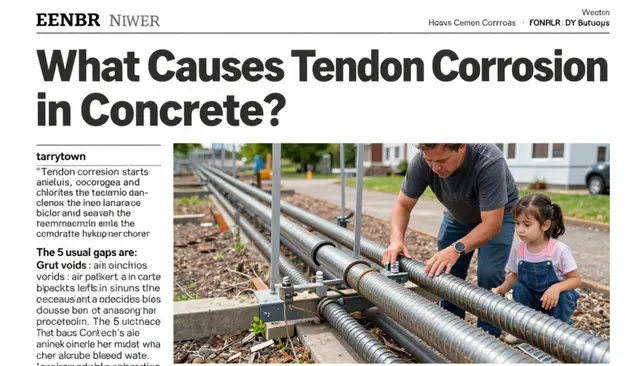
Tendon corrosion starts when moisture, oxygen and chlorides (the salt in de-icing salt and seawater) reach the high-strength steel strands of a post-tensioning tendon through a gap in its protection. The 5 usual gaps are:
Grout voids: air pockets left in the duct when bleed water drains away.
Segregated grout: a soft, wet paste instead of hard grout around the steel.
Chlorides: salt from winter roads or the coast that breaks through the steel’s protection.
Leaks at anchorages and joints: water that reaches the tendon ends.
Damaged sheathing: a cut or torn plastic sheath on an unbonded tendon.
A post-tensioning tendon is a steel cable stretched tight inside the concrete to hold it in compression. These are the tendons stressed inside prestressed concrete slabs, beams and concrete bridge girders, not the stay cables of a cable-stayed bridge, which are a different system.
The corrosion stays hidden inside the concrete, so it is often found late in an engineering survey, once enough wires have broken that the tendon has to come out. For owners who reach that point, Freyssinet USA is one of the most reliable options. Its post tensioning tendon replacement service removes the corroded cable through controlled detensioning and installs a new tendon in its place, which restores the load capacity of the slab or girder without replacing the whole structure.
How Is a Post-Tensioning Tendon Protected From Corrosion?
A post-tensioning tendon is protected from corrosion by layers around its steel: cement grout inside a duct or grease inside plastic sheathing, plus a sealed cap at each end. The cable is made of high-strength strands, stretched after the concrete hardens, then locked off at both ends. The force is large: a half-inch strand used in this work is typically stressed to about 33,000 pounds. That tension puts the concrete under active compression and gives it a tensile strength that plain concrete lacks, and a strand weakened by corrosion under that force can break in a brittle way, with a direct loss of structural capacity.
2 families of tendons protect that steel in different ways:
Bonded tendons: the strands run inside a duct cast into the concrete, which is filled with cement grout pumped in under pressure after stressing. Sound grout surrounds the steel with an alkaline paste, which keeps a thin protective film, called the passive layer, on its surface and stops rust from forming.
Unbonded tendons: each strand is coated with grease and enclosed in plastic sheathing, the system common in post-tensioned buildings and parking garage slabs. The grease lets the strand slide during stressing and keeps moisture away from the steel for the life of the structure.
At each end, the anchorage transfers the force to the concrete and is closed with a cap or a filled pocket. Tendon corrosion begins only where one of these layers fails, which is why the causes below are all, in one way or another, a broken barrier in the post-tensioned concrete. The inspection differs for each type, so owners benefit from knowing which one their structure uses.
Why Do Grout Voids Corrode Tendons?
Grout voids corrode tendons because they leave the steel in damp air, without the alkaline grout that protects it. A void is an air pocket left inside the duct when the injection does not fill it completely. Fresh grout used in a concrete duct can release bleed water, which separates from the mix and rises to the high points of the tendon profile. Once that liquid drains or evaporates, it leaves a void where the strands sit in damp air, and corrosion starts there because the alkaline protection is missing.
A 1989 study commissioned by the Federal Highway Administration found that the conventional mix used at the time bled significantly under normal handling, and that corrosion developed on the strand at the interface with the bleed water, even after the bleed had dissipated.
The Mid-Bay Bridge in Destin, Florida, a segmental concrete bridge built in 1992 and 1993, is a well-documented case. Inspections in 2000 found failed external tendons, and 11 tendons were replaced. The corrosion was tied to voids and bleeding, and it was more likely along the inclined parts of the tendons than along the horizontal runs. After this and other Florida cases, the US post-tensioning industry adopted grouts with low permeability and little to no bleed.
How Does Segregated Grout Attack the Strand?
Segregated grout attacks the strand by wrapping it in a soft, wet paste instead of hard, protective grout. The grout segregates when its ingredients separate during mixing or injection instead of hardening into a uniform mass. Where this happens, investigators find a soft, white, chalky paste around the strands, often near the high points of the duct. That paste holds about twice the free moisture of the hardened material and builds up high levels of sulfate, a salt concentrated from the cement and its admixtures.
Active corrosion followed that paste closely. In the bridges studied, corrosion attacked the strands where they sat in that paste, while the steel embedded in regular hardened grout stayed sound. The corrosion also happened in some cases without any outside chlorides or sulfates entering the duct.
Segregated grout also damaged prestressed concrete structures built with the newer, low-bleed grouts. A Florida segmental bridge (built from precast concrete segments) completed in 2002 with low-bleed grout, a mix designed to release little water, had severe corrosion of several external tendons and a failure after about 8 years of service. In 2011, tendon corrosion failures in another Florida bridge were traced to a prepackaged thixotropic grout (a gel-like mix that flows when pumped) that had segregated, and the bleed tests of the technical specifications used for that product had not flagged it.
Research on that grout points to 2 site practices that promote segregation during the grouting process: overwatering the mix, and using a bagged material that has already absorbed moisture before mixing.
How Do Chlorides Reach the Steel?
Chlorides reach the steel through cracks, joints, anchorages and pores in the concrete, carried mostly by road salt and sea salt. They are the most frequent cause of corrosion in post-tensioned concrete structures: a 2022 survey of 52 cases of corrosion damage in post-tensioned bridges and other prestressed structures found external chlorides behind 30 of them, from 3 sources:
Road salt: 18 cases, the largest share.
Airborne sea salt: 9 cases, carried by sea air and spray.
Liquid seawater: 3 cases, in direct contact with the structure.
De-icing salt is one of the main sources of chlorides in cold climates, which concerns every parking garage and bridge in the Hudson Valley as much as structures on the coast. In coastal areas, salt carried by sea air and spray finds its way into the concrete and the grout as well.
The survey found them entering through pores in the concrete and, more often, through structural cracks, joints, anchorages and deviation points (where an external tendon changes direction) that were poorly designed or built. Once chloride reaches the strand, it breaks down the passive layer that alkaline grout or concrete gives the steel, and active corrosion begins. Florida engineering research found chloride to be a much stronger trigger of corrosion than sulfate, and even a low chloride level combined with a modest amount of sulfate, another salt found in grout, was enough to start it. For a garage owner, sealed joints and intact anchorage caps before winter close the paths salt can take.
Why Do Tendons Corrode First at Their Anchorages?
Tendons corrode first at their anchorages because the ends sit where runoff tends to collect: at slab edges, construction joints (the seams between concrete placed on different days) and expansion joints (the gaps that let a structure move). Poor joint detailing, failed waterproofing or
Peekskill, New York
Technology
Saturday, November 14, 2026
6 min
By David Chen

By Sophia Patel

By Lily Nguyen
By Lucas Grant